
Insulation · Ceramic Fibre
Eight ceramic-fibre product types — one supplier
Ceramic fibre is the modern thermal-insulation choice — five-times-lighter than IFB, near-zero heat storage, fastest heat-up cycles in the industry. Stocked across the full eight-product range (bulk, blanket, module, board, paper, rope, textile, shape) in 1260, 1430 and 1600 °C grades for service from boiler casings to petrochemical reformer crowns.
1260-1600
°C Service Range
8
Product Types Stocked
Module
Crowns Engineered
Same-Day
Pune-Belt Dispatch
Overview
Ceramic Fibre — what they are, when to specify
Ceramic fibre is high-purity alumino-silicate (or higher-grade alumina-rich) fibre spun from molten material. The fibre web traps air, giving the lowest thermal conductivity of any commercial refractory insulation, with effectively zero thermal mass — the lining heats up in minutes rather than hours and stores almost no energy when the furnace is shut down.
Product Types
Forms we stock
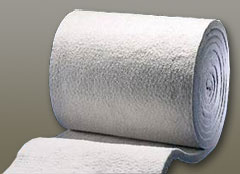
Blanket (96-160 kg/m³)
Roll-form, needled blanket. The backbone product — wrapping, layering, anchoring on furnace shells.
Modules (160-220 kg/m³)
Folded blanket assemblies anchored on stud welds. Best for crowns and large-area linings — fastest installation per m².
Board (160-300 kg/m³)
Rigid board for backup behind brick/castable, casing protection, ducting.
Bulk Fibre
Loose fibre for filling cavities, casting fibre-castable mixes, expansion-joint packing.
Paper (160-200 kg/m³)
Thin sheets for gaskets, expansion joints, seal-strips.
Rope & Braid
Round and square ropes for joint-packing, door-sealing, expansion joints.
Textiles (Cloth/Tape)
Woven cloth and tape for thermal-protective applications, welding curtains.
Vacuum-Formed Shapes
Cylinders, end-caps, custom shapes vacuum-formed to drawing.
Grades
Stocked grades — pick by service condition
Indicative properties only. Final specification is set per application after we review your operating envelope.
| Grade | Composition | Service Limit | Typical Application |
|---|---|---|---|
| 1260 °C Standard (RCF) | Al2O3 + SiO2 ~96% | 1260 °C | Boilers, fired heaters, ceramic kilns |
| 1260 °C HP (High Purity) | Lower iron/alkali | 1260 °C | Aluminium contact, glass tank backup |
| 1430 °C Zirconia Grade (Z) | with 15% ZrO2 | 1430 °C | Reheat furnace doors, kiln crowns |
| 1600 °C Poly-Crystalline (PCW) | Mullite/PCW fibre | 1600 °C | Petrochemical reformers, ammonia plants |
| Bio-Soluble Fibre (AES) | CaO-MgO-SiO2 | 1100-1200 °C | Lower-temp service, regulated environments |
Modules supplied with stainless-steel anchor hardware. Paper and rope cut-to-length on indent. Vacuum-formed shapes built to drawing.
Datasheets available on request — email punesales@chaneyco.com with your specification and we will send the matching PDF.
Applications
Where ceramic fibre are specified
Petrochemicals
Reformer crowns, ammonia secondary reformer modules, fired heater linings
Steel & Foundry
Reheat furnace doors, soaking pit covers, ladle covers
Cement & Lime
Kiln-feed end seals, cooler-grate insulation
Glass & Ceramics
Forehearth covers, anneal lehr insulation
Power & Energy
Boiler casing insulation, expansion joints, hot-gas ducts
Aluminium
Holding furnace covers, tundish covers, crucible insulation
Why Chaneyco
Three reasons buyers source ceramic fibre from us
Stocked at Chakan, dispatched fast
Ceramic Fibre are held at our Chakan plant in Pune. Standard grades dispatch same-day to plants in the Pune industrial belt and within days pan-India by road or rail.
Spec advice before quote
Choosing the right grade for the operating envelope makes a much bigger lifecycle-cost difference than haggling on the cheapest grade. Our technical team will recommend by zone before quoting.
ISO 9001:2015 audit-ready
Every batch ships with composition and dimensional QC records, supported by our ISO 9001:2015 certification (Cert. 11553, AQSR / USAC accredited, valid through 17 Sept 2027).
Frequently Asked
Ceramic Fibre questions, answered
Module crown vs blanket layered — which?
Modules deliver faster installation (≥ 1.5x m²/day per crew vs. layered blanket), uniform compression and no anchor exposure to the hot face. Blanket layering is cheaper per m² and suits irregular geometries. For large flat or curved crowns, modules win on lifecycle cost; for small awkward zones, blanket wins on flexibility.
Bio-soluble (AES) vs RCF — when?
Bio-soluble (low-bio-persistence) fibre is increasingly required by regulation in Europe and parts of Asia for service below ~1100 °C. Performance at temperature is similar to standard RCF in this range but the workplace exposure profile is materially safer. We stock both — pick AES where regulation requires it or where you want to upgrade workplace safety.
Can you supply pre-engineered module crowns?
Yes. Send us furnace dimensions and operating temperature and we will engineer the module layout, anchor pattern and hardware schedule. Modules ship pre-folded and ready to install, with anchor hardware in matched lots.
Talk to a Refractory Engineer
Tell us about your application
Share the basics — furnace type, operating temperature, atmosphere, the lining zone you are specifying. Our technical team responds within one working day with grade recommendation, indicative quote and lead time.